The short answer
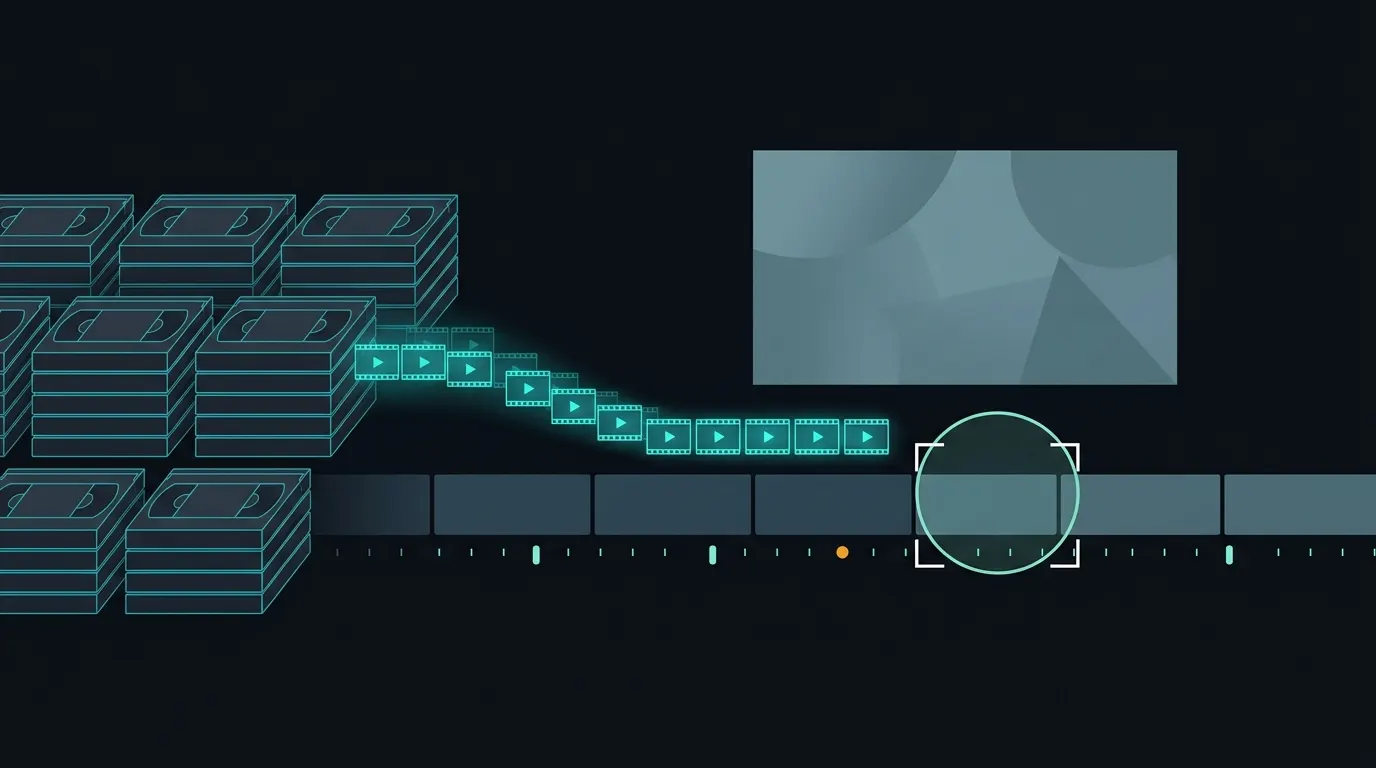
A searchable video archive is one where an editor can type a question and land on the right moment in the right recording, not just on a tape number in a catalogue. For most broadcasters, getting there is a programme of four parts. Move the footage off tape and other ageing carriers into managed files. Keep a preservation master of each recording and lighter copies for viewing and processing. Bring old catalogue records, shot lists and rights information into one metadata structure. Then add time-coded indexing, such as transcripts, on-screen text and shot boundaries, so that search reaches inside each recording rather than stopping at its title. AI makes the last step affordable at archive scale, but it depends on the first three: an index built on unreadable files, missing timecode or unknown rights produces results nobody can use.
Digitise first: tape is a deadline, not a backlog
Archive specialists treat legacy video carriers as a deadline. A 2011 report prepared for the Library of Congress, published through the Federal Agencies Digital Guidelines Initiative (FADGI), states that all analog video formats are obsolete, defining obsolete as playback machines no longer being in production, and that all tape-based digital video formats are either obsolete or will be soon. Its starting assumption is that all historic video formats must be migrated into file-based digital form. Three of its recommendations matter for a broadcaster planning transfers. For analog tape, and for digital tapes such as Digital Betacam whose recorded data can only be played out through SDI, it recommends 10-bit uncompressed capture and rules out lossy compression for preservation copies. For formats whose recorded bits can be read directly, such as the DV family, XDCAM and P2, it recommends transferring the data without transcoding, which keeps the metadata recorded at the time, including timecode and in some cases time of day and GPS location. And it warns that one tape can carry several timecode sources, such as control track, LTC and VITC, that do not always match, so which one to keep is decided tape by tape. When ordering the work, start with the carriers whose playback equipment is hardest to find and the material most likely to be reused.
Keep a master, then make copies people and machines can use
A digitised recording is not one file but a family of files. The US National Archives describes three levels for video. A preservation master is captured at high to maximum quality, kept long term in managed storage, and may take the place of the original if the original is lost or damaged. A reproduction master is a moderate to high quality file used as the source for lower quality derivatives. Distribution copies, MP4 in NARA's product list, favour small files and fast transfer over quality and need not be kept once their access purpose is met. For search, the consequence is practical: run indexing, previews and AI processing on a light access copy, and link it to the master by a shared identifier and matching timecode, so a moment found in the proxy can be pulled from the master at full quality. The FADGI report adds one detail worth keeping in the access copy too: closed captions recorded on line 21 of NTSC tapes can be extracted during transfer, for example to a SubRip (.srt) file. An old caption track is a ready-made, time-coded transcript.
One metadata structure for old records and new tags
Most broadcast archives already hold metadata, spread across tape labels, shot lists, a library database, rundowns and rights spreadsheets. Before adding anything new, map what exists into one structure. Two broadcast schemas are common reference points. PBCore, developed by US public broadcasting so that producers and stations could share, manage and preserve media, describes itself as a cataloging standard and data sharing tool for audiovisual content. It separates the intellectual content of a programme from its instantiations, the individual physical and digital copies with their own format, duration and file details, which suits an archive where one programme exists as a tape, a preservation file and a proxy; it also has rights summary and rights link elements. EBUCore, which the European Broadcasting Union calls the flagship of its metadata specifications, covers descriptive and technical metadata and is published as an XML schema and an RDF ontology; the EBU now presents EBUCorePlus, which merges EBUCore with its CCDM model, as able to replace its predecessors. Whichever you choose, record process history as well: what the source carrier was and which tools and settings transferred it. The FADGI report lists this as its own category of technical metadata, and it lets later migrations and quality checks trace every file back to its origin.
Add time-coded indexing and keep rights in the results
With files, identifiers and a schema in place, indexing can reach inside each recording. Speech becomes a transcript with timestamps. Text shown on screen, such as the name in a lower third or a place caption, becomes searchable through optical character recognition. Shot and scene boundaries turn a long programme into units that can be previewed and clipped. Labels for objects, places and activities help with visual queries such as a flooded street or a press conference. Each tag should carry the asset identifier, its start and end timecode and a confidence score, and be marked as machine-generated so archivists can filter and audit it; our guide to AI video tagging covers what these models return and where they go wrong. Rights deserve the same treatment as content. A result an editor cannot use is worse than no result, so rights status, restrictions and expiry should sit in the same index as the transcript and be applied as filters, keeping restricted material out of searches meant for publishing.
Faces and names: settle the policy before you switch it on
Identifying people is the most requested archive search and the one with the most legal weight. In the EU, Article 4(14) of the GDPR defines biometric data as personal data resulting from specific technical processing of a person's physical, physiological or behavioural characteristics that allow or confirm their unique identification, and names facial images as an example. Article 9(1) prohibits processing biometric data for the purpose of uniquely identifying a person unless one of the exceptions in Article 9(2) applies. These include explicit consent, data manifestly made public by the person, and archiving in the public interest, the last only on the basis of Union or Member State law with safeguards. Article 85 leaves it to each Member State to reconcile data protection with freedom of expression, including journalism, so the answer differs by country. This is not legal advice, and other jurisdictions have their own rules. In practice, many questions about people can be answered from what the archive already says: names in lower thirds found by OCR, speaker names in transcripts, and catalogue records. Decide with counsel whether face matching is needed on top, for which people and with what review, before enabling it.
Where Minute-ly.com fits
Indexing pays off when the same analysis feeds more than a search box. Minute-ly.com's Video AI Engine connects to video libraries, VOD, cloud storage, live streams and broadcast feeds, and its video understanding identifies scenes, people, speakers, action and context as a common foundation for downstream work. From that analysis, configured workflows produce chapters, summaries, highlights, previews, captions and vertical versions through Smart Composition, and structured metadata can be sent to connected systems to support search. Source formats, identifiers, output destinations and review steps are agreed with the integration team for each deployment, starting with representative material and acceptance criteria rather than the whole archive.
Checklist for an archive search project
Inventory the carriers and formats you hold, and rank them by playback risk and reuse value. Choose transfer specifications per format: uncompressed 10-bit capture for analog and SDI-only digital tape, bit-for-bit transfer where the recorded data can be read directly. Keep a preservation master and an access copy for every recording, linked by one identifier and matching timecode. Extract legacy closed captions during transfer. Choose a metadata schema, map existing catalogue and rights records into it, and record process history. Index transcripts, on-screen text and shot boundaries with timecodes and confidence scores, marked as machine-generated. Put rights status and restrictions in the search index as filters. Settle the policy on identifying people before enabling face features. Pilot on a representative sample, measure how long it takes editors to find footage before and after, then scale.